So, you're thinking about going electric. The big question on everyone's mind is usually the same: Will I actually save money on maintenance? The answer is a clear and simple yes. In fact, electric car maintenance costs are significantly lower than what you're used to with a gas-powered car. This all comes down to the EV's much simpler design—you can wave goodbye to oil changes, spark plugs, and entire exhaust systems.
The True Cost of Electric Car Ownership
Making the switch from gasoline to electric is a bit like trading in a complex mechanical watch for a modern smartwatch. The old watch is a beautiful but intricate device, packed with tiny gears and springs that need constant attention and specialized repairs. The smartwatch, on the other hand, is mostly solid-state. It has very few moving parts, which means it needs far less hands-on care. That's the perfect way to think about the core reason for lower electric car maintenance costs. A gasoline engine is a mechanical masterpiece, but it's also a complex system of hundreds of parts—pistons, belts, filters, and valves—all working under extreme heat and pressure. Every single one of those parts is a potential point of failure that needs regular service. An EV, by comparison, runs on a much more straightforward principle. Its electric motor has just a handful of moving parts, leading to dramatically less wear and tear over time. This elegant, streamlined design translates directly into real, tangible savings for you.
Why EVs Cost Less to Maintain
The financial perks come from a few key differences in how electric vehicles are engineered. You get to cross a whole list of common service items off your to-do list for good.
- No More Oil Changes: This is a big one. Electric motors don't use engine oil, which completely eliminates one of the most frequent and consistent expenses for traditional car owners.
- Fewer Fluids to Replace: Aside from windshield washer fluid and brake fluid, there are far fewer liquids to top off or flush. The battery's coolant system needs attention, but the service intervals are much, much longer.
- A Radically Simpler Drivetrain: With no spark plugs, timing belts, fuel filters, or exhaust systems, there are simply fewer components that can wear out or fail.
- The Regenerative Braking Advantage: EVs cleverly use their motor to slow the car down, capturing that momentum and converting it back into battery energy. This does most of the "braking" work, meaning your brake pads and rotors last significantly longer.
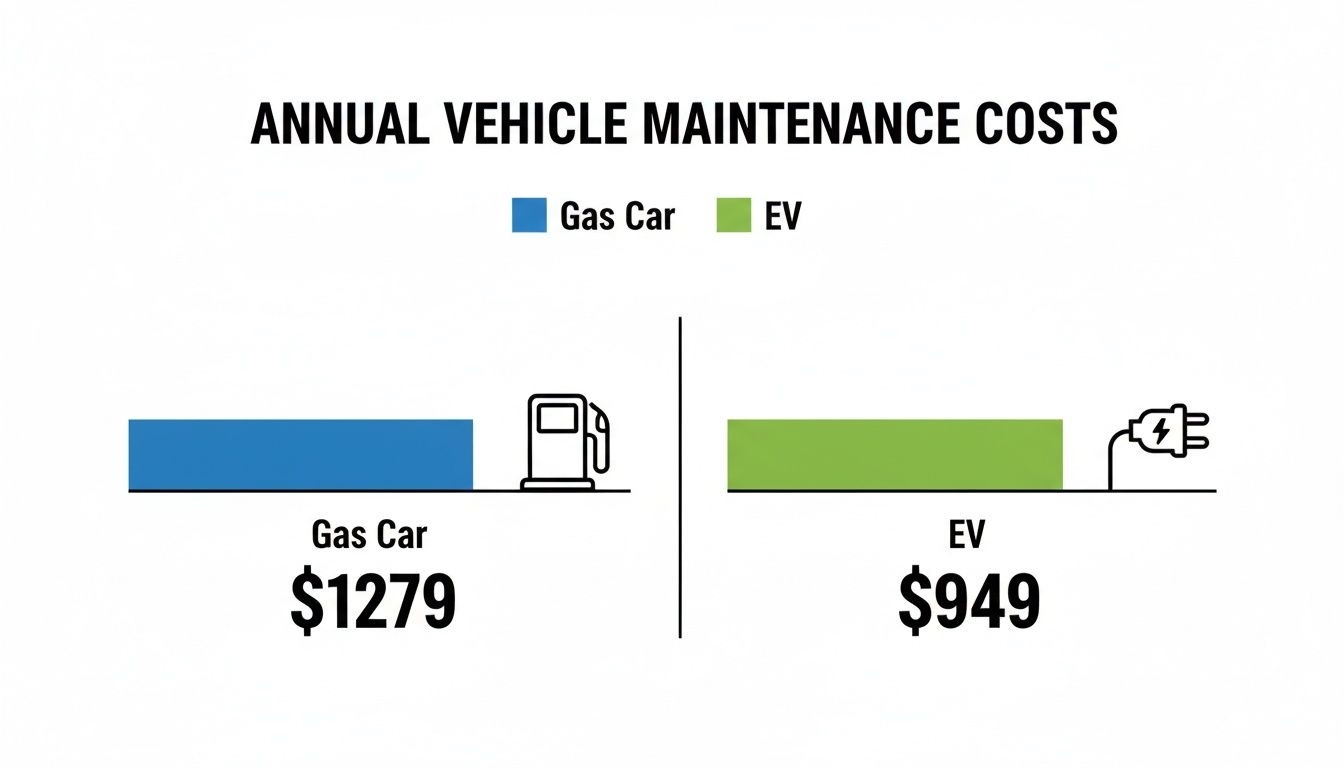
This isn't just theory; the data backs it up. Studies show that EV owners spend an average of $949 annually on maintenance. That's a full $330 less than what gas car owners typically pay. Over the lifetime of the vehicle, those savings really add up to thousands of dollars.
Ultimately, these fundamental design advantages are what drive down the true cost of owning an electric car. You'll spend less time in the service center and keep more money in your pocket, making that Kia EV6 or EV9 an even smarter investment for the long haul.
Putting EV and Gas Car Maintenance Bills Head-to-Head
So, where do the real savings come from? To get a feel for the difference, it helps to look at exactly what you're paying for with a gas car versus what you're not with an electric one. Once you compare the typical maintenance checklists side-by-side, the financial upside of going electric becomes incredibly clear. A traditional gasoline engine is a mechanical marvel of complexity, with hundreds of moving parts—pistons, spark plugs, belts, and filters—all working in a hot, high-friction environment. They need constant lubrication and regular replacement parts just to keep running smoothly. An EV motor, on the other hand, is refreshingly simple. With just a handful of moving parts, there’s far less to wear out, break down, or service.
Eliminating Common Service Costs
The biggest and most immediate savings come from the long list of maintenance tasks that EVs simply don't need. We're not just talking about saving a few bucks on an oil change; entire categories of recurring service appointments are wiped off the calendar for good. This table really puts the difference into perspective.
Typical Maintenance Needs: EV vs. Gas Car
| Maintenance Item | Electric Vehicle (EV) | Gasoline Vehicle (ICE) |
|---|---|---|
| Oil and Filter Changes | Not required | Every 5,000-10,000 miles |
| Spark Plugs | Not required | Every 30,000-60,000 miles |
| Timing Belt | Not required | Every 60,000-100,000 miles |
| Fuel Filter & System | Not required | Periodic replacement needed |
| Exhaust System | Not required | Prone to rust and damage |
| Brake Pad Wear | Significantly reduced | Regular replacement |
As you can see, the most common reasons you'd visit a mechanic with a gas car—oil changes, spark plugs, exhaust work—are non-existent with an EV. Over the lifetime of the vehicle, the money you save by skipping these appointments can easily add up to thousands of dollars.
The Power of Regenerative Braking
One of the coolest features impacting electric car maintenance costs is regenerative braking. It's not just a clever way to boost your range; it's a built-in money-saver that actively protects one of your car's most important wear-and-tear items. Here’s how it works: the moment you ease off the accelerator, the electric motor essentially runs in reverse. It captures the car's kinetic energy and converts it back into electricity to recharge the battery. This creates a natural braking force that slows the car down, so you don't have to hit the brake pedal nearly as often in everyday driving.
For the average driver, this means brake pads and rotors can last two to three times longer than they would on a comparable gasoline car. This drastically reduces one of the more expensive routine maintenance jobs, adding another layer of savings to your EV ownership experience.
Your Annual EV Service Checklist
It's one thing to hear that an EV needs less maintenance, but it’s another to know what actually happens when you bring it in for service. That's where the real peace of mind comes from. A yearly check-up for your Kia EV isn't about swapping out grimy engine parts; it’s about smart, proactive inspections that keep your car running safely and at its peak. Think of it as a shift from reactive repairs to preventative care, which is a big reason why electric car maintenance costs are so much lower. The service schedule itself is refreshingly simple. Instead of worrying about oil sludge or timing belts, your technician is focused on the components that EVs and gas cars share, plus a few systems unique to electric vehicles. This makes sure all the key safety and performance systems are in top condition. And the data backs this up—this simpler service model translates directly into real savings. This chart really puts the numbers into perspective. On average, EV owners are spending $330 less every single year than folks driving traditional gas-powered cars.
Your Essential Maintenance Tasks
So, what can you actually expect during that yearly appointment? The checklist is pretty straightforward and focuses on the parts of your EV that see the most action. A certified technician will usually handle these key services.
- Tire Rotation and Inspection: This might be the single most important task on the list. EVs are heavy and deliver instant torque, which can wear tires down faster and less evenly. Regular rotations, usually every 5,000 to 7,500 miles, are crucial for getting the most life out of your rubber.
- Brake System Check: Regenerative braking handles most of the slowing down, but your traditional hydraulic brake system still needs love. A technician will check the brake fluid for contamination and inspect the pads and rotors for any unusual wear to make sure they're ready to go when you need them most.
- Cabin Air Filter Replacement: Just like any other car, this filter keeps pollen, dust, and other junk out of the air you breathe inside. Swapping it out annually keeps your cabin fresh and helps your HVAC system work efficiently.
- Battery and Coolant System Inspection: The thermal management system is the unsung hero of your battery's health and longevity. During a service, a technician will check the coolant levels and look over the high-voltage battery components for any signs of damage, ensuring everything is operating safely.
Sticking to this simple annual schedule does more than just keep your EV in peak condition—it also helps protect its resale value. It’s a small investment of your time that prevents bigger headaches down the road and keeps your total cost of ownership refreshingly low.
What to Know About EV Battery Health and Longevity
Let’s get right to it and talk about the elephant in the room: the battery. For a lot of people thinking about buying an EV, the fear of a battery dying and hitting them with a massive replacement bill is the number one worry. But the reality of how these batteries perform over time is a lot less scary than the rumors, and it shouldn't be a major factor in your electric car maintenance costs. Outright, catastrophic battery failures are incredibly rare. To give drivers peace of mind, manufacturers like Kia back their batteries with some seriously robust, long-term warranties. A typical EV battery warranty covers the pack for 8 years or 100,000 miles, whichever comes first. This isn't just a gimmick; it's a solid guarantee against manufacturing defects and any significant loss of capacity, protecting your investment for the long haul.
Understanding Battery Degradation
A term that often causes confusion is battery degradation. It’s important to know this isn't a sudden "lights out" failure. Instead, it's a slow and gradual decline in the battery's ability to hold a full charge, happening over many, many years. The best analogy is your smartphone—after a few years, the battery probably doesn't last as long as it did out of the box, but it still works perfectly fine for your daily needs. This is a natural process for any lithium-ion battery. The good news is that modern EVs have sophisticated thermal management systems designed specifically to protect the battery from extreme temperatures, which is the main culprit behind accelerated aging. Most owners will only ever notice a minor dip in their total range after years and years of driving.
The fear of a five-figure battery replacement bill is largely unfounded. Most owners will go the entire lifespan of their vehicle without ever needing to worry about it. For perspective, the vast majority of battery issues are handled under the vehicle's original warranty, costing the owner nothing.
Even in those very rare cases where a battery issue pops up after the warranty has expired, the costs are often more manageable than you'd think. Technicians can frequently replace just the individual faulty modules inside the battery pack rather than swapping out the whole expensive unit. This drastically cuts down the repair bill. If you want to dig deeper into how technology and warranties keep EV ownership affordable, check out these insights from Pod Energy.
How to Maximize Your Battery's Lifespan
While EV batteries are built tough, you can absolutely play a part in keeping yours in prime condition. A few simple tweaks to your daily habits can help preserve its capacity and extend its life even further. Here are a few best practices to get the most out of your Kia EV's battery:
- Avoid Regular Deep Discharges: Try to avoid letting your battery level routinely drop below 20%. Constantly draining it that low puts a little extra stress on the battery cells over time.
- Target an 80% Charge for Daily Driving: For your normal day-to-day commute, charging up to 80% is much gentler on the battery than pushing it to a full 100% every single time. Save that full charge for when you actually need the maximum range for a long trip.
- Minimize Exposure to Extreme Heat: Whenever you can, park your EV in the shade or a garage on those sweltering summer days. The car’s own cooling system does a great job protecting the battery, but avoiding extreme ambient heat reduces its workload.
- Limit Frequent DC Fast Charging: Fast chargers are a lifesaver on road trips, but relying on them for all your charging can generate more heat and may lead to slightly faster degradation over the long run. For daily top-ups, a Level 2 home charger is the ideal way to go.
Why Certified Technicians Matter for Your Kia EV
Your Kia EV is a seriously advanced piece of machinery, a complex dance between a powerful battery and sophisticated software. While one of the best perks of owning one is less maintenance, that doesn't mean no maintenance. When your EV does need a check-up, who you trust with the job is one of the biggest decisions you'll make for controlling long-term electric car maintenance costs and protecting your investment. Think of it this way: a traditional mechanic is like a great family doctor, but a certified EV technician is a heart surgeon. Both are medical pros, but you wouldn't ask your GP to perform open-heart surgery. Your EV’s high-voltage battery and powertrain are its heart, and only a specialist has the training and tools to work on it safely and correctly.
The Value of Specialized Training and Tools
Certified Kia technicians don't just know cars; they know your car. They go through intense, factory-direct training specifically for models like the EV6 and Niro EV. This isn't your average auto shop class—it covers everything from decoding complex software glitches to safely handling the high-voltage systems that are genuinely dangerous in untrained hands. They also have access to diagnostic equipment that independent shops just can't get. These tools talk directly to your Kia’s brain, allowing for pinpoint-accurate troubleshooting that takes the guesswork out of repairs.
Taking your EV to a non-certified mechanic is a roll of the dice. A small mistake can cause expensive damage to the vehicle's sensitive electronics or, even worse, void parts of your warranty. That small issue could quickly become a huge headache.
Genuine Parts and Warranty Protection
Expertise is only half the battle. A certified service center like Habberstad Kia is committed to using only genuine Kia parts. These aren't just generic replacements; they are built to the exact specs of your vehicle, guaranteeing they'll fit perfectly and perform as they should. Aftermarket parts might seem cheaper upfront, but they can easily compromise your EV’s safety, performance, and even its lifespan. For Long Island drivers, this all adds up to peace of mind. Choosing a certified team ensures your vehicle is in the hands of pros who know its technology inside and out. It’s the smartest way to maintain its reliability and keep your warranty completely valid.
Got Questions About EV Maintenance? We've Got Answers.
Jumping into an electric vehicle is exciting, but it’s natural to have a few questions about what ownership really looks like day-to-day. While the long-term savings are a huge plus, new technology can feel a little uncertain. Let's clear the air. We’ve put together straightforward answers to the most common questions we hear about electric car maintenance costs. Think of it as a cheat sheet for feeling totally confident about your switch to electric.
Is It True That EVs Wear Out Tires Faster?
You’ve probably heard this one, and yes, there’s some truth to it. Tires on an EV often wear down a bit quicker than on a similar gas-powered car, but it’s not due to a flaw. It's a direct result of two things that make EVs so great to drive. First up is instant torque. The second your foot touches the accelerator, the motor delivers all its power. That incredible responsiveness is a blast, but it does put more immediate stress on the tire's rubber. Second, that big battery pack means EVs are heavier than their gas-guzzling cousins. All that extra weight naturally puts more of a load on the tires, which can lead to faster wear over time. The good news? It's easy to manage. A few simple habits will keep your tires in great shape:
- Rotate, Rotate, Rotate: This is your best defense. Getting your tires rotated every 5,000 to 7,500 miles is the single most effective way to make sure they wear evenly.
- Get the Right Gear: Tire manufacturers have caught on. You can now find EV-specific tires made with tougher compounds and reinforced sidewalls, built to handle the unique demands of an electric vehicle.
- Check Your Pressure: Keeping your tires inflated to the recommended PSI isn’t just good for tire life—it’s also essential for getting the maximum range from every charge.
Are There Any Fluids I Need to Check in an EV?
You can officially say goodbye to messy, expensive oil changes! But that doesn't mean EVs are completely fluid-free. The list is just a whole lot shorter, and you’ll be dealing with them far less often, which is a big part of the cost savings. You'll still have the basics like windshield washer fluid (for seeing where you're going) and brake fluid, which needs to be checked for safety just like in any other car. The most important fluid unique to an EV is the battery coolant. This is the lifeblood of the thermal management system, a crucial network of lines that circulates liquid to keep your battery pack in its happy place—not too hot, not too cold. This system is a huge factor in both your car's performance and the long-term health of its battery. A certified technician will check it during your annual service, but a full flush is rarely needed before 100,000 miles or more.
What Happens When the EV Battery Warranty Runs Out?
This is a big point of anxiety for a lot of people, but it’s mostly based on a misunderstanding. An expiring warranty doesn't mean your battery is about to give up. Far from it. EV batteries are built to last the life of the car. Most will still hold a huge percentage of their original charge long after the typical 8-year or 100,000-mile warranty is up.
Think of the warranty as a safety net protecting you from a rare, premature problem—not a ticking clock counting down to a giant repair bill. The vast majority of owners will never need a post-warranty battery replacement.
Even in the rare case that your battery does lose significant capacity years down the road, the fix is often much cheaper than you'd imagine. A certified service center can run diagnostics and often replace just the specific faulty modules inside the battery pack, which costs a fraction of what a full replacement would. Plus, as more EVs hit the road, the market for refurbished batteries and third-party repair options is growing, which will only make long-term ownership more affordable.
Can I Just Take My Electric Kia to My Usual Mechanic?
While it might be tempting to head to your trusted local shop, it's a bad idea for an EV. We strongly recommend you only entrust your electric Kia to a certified service center. An EV's high-voltage system is a completely different beast than a gasoline engine, and it requires specialized training, tools, and safety protocols that most independent shops just don't have. Our technicians at a certified dealership have gone through extensive, factory-specific training on your car’s advanced electronics. They also have access to proprietary diagnostic software that can pinpoint issues a generic code reader would completely miss. Trying to save a few bucks at an uncertified shop carries some serious risks:
- Safety Hazards: Working on high-voltage systems without the right training is incredibly dangerous.
- Risk of Damage: One wrong move could lead to thousands of dollars in damage to the battery or other critical electronics.
- Voiding Your Warranty: If an unapproved mechanic uses non-genuine parts, it could invalidate your vehicle's warranty coverage.
For your own safety and the long-term health of your car, always stick with technicians who are certified to work on your electric Kia.
Ready to experience the low-maintenance, high-fun world of an electric Kia? The team at Habberstad Kia is here to help. Schedule a test drive or book your next service appointment with our certified EV technicians to keep your Kia in peak condition. Visit us online to get started.